
Jutye Sanitary
The 2026 Kitchen Sink Drain Basket market reflects a practical shift toward hygiene, durability, and easier daily maintenance. Industry reports from the National Kitchen & Bath Association and Houzz show that homeowners increasingly value resilient fixtures, streamlined storage, and low-maintenance kitchen surfaces. These trends make the Kitchen Sink Drain Basket more important than its small size suggests. It catches food particles, protects drainpipes, and keeps standing water from collecting around the sink opening.
Certified kitchen designer Susan Serra, CKD, has often emphasized that “the kitchen should work as beautifully as it looks.” That principle applies directly here. A basket with a tight, stable fit can prevent scraps from slipping underneath its rim. A stainless-steel model may resist staining, while a removable perforated cup can simplify cleanup after washing vegetables or greasy plates. Small details matter.
Yet buying decisions are not always straightforward. A basket may fit the drain but fail under heavy use. Some “rust-resistant” finishes still discolor in harsh cleaning environments. The 2026 guide therefore compares diameter, hole pattern, material grade, rim design, overflow compatibility, and cleaning effort. It also questions marketing claims where testing information remains unclear. Good kitchen equipment should perform quietly, repeatedly, and without demanding attention.
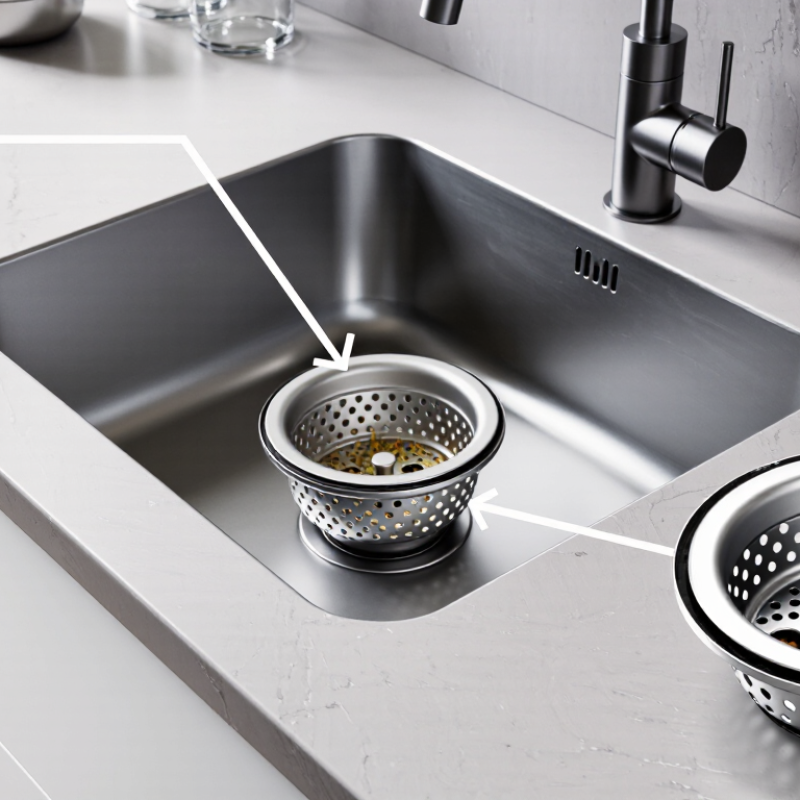
Kitchen sink drain baskets come in several forms: removable-basket strainers, fixed perforated strainers, and deeper baskets that hold more food scraps. A removable basket is easier to lift and rinse. Fixed designs can look simpler, but may be less convenient when debris collects. Fit matters. Many kitchen sinks use a 3.5-inch drain opening, yet that measurement alone does not confirm compatibility. Measure the opening and check the product’s flange diameter, thread size, and sink thickness range. Not every sink matches.
ASME standards are worth checking, but read the scope carefully. ASME A112.18.2/CSA B125.2 covers plumbing waste fittings; it does not mean every loose drain basket is independently certified. Look for clear information about the complete strainer assembly, materials, and applicable testing. Stainless steel resists corrosion, while rubber or silicone seals help limit leaks. A poorly seated gasket can still cause trouble. Small details matter. If installation instructions are unclear, ask a qualified plumbing professional rather than forcing mismatched threads.
Tips: Before buying, remove the old basket and measure the opening across its widest points. Compare the measurements with the installation sheet, not just the listing title. Check twice. Choose a basket that lifts out without scraping the sink, and keep its seal clean. One overlooked detail is basket depth: a deep model may interfere with plumbing below the sink, so check the available clearance.
2026 Top Kitchen Sink Drain Basket Buying Guide
How to Measure Sink Openings Using 3.5-Inch Industry Dimensions
A 3.5-inch drain opening is a common kitchen sink dimension. However, nominal size can mislead. The basket flange is usually wider than the hole. Measure the opening, not the visible rim. Remove the old basket first. Clean away putty, rust, and food residue. Place a ruler across the widest point. Then measure again at a right angle. Both readings should stay close to 3.5 inches.
Small differences matter. An opening near 3.4 inches may accept a standard basket. A larger opening may require a different flange or adapter. Check the sink material, too. Stainless steel often has a pressed opening. Fireclay and composite sinks can have less forgiving edges. ASME A112.18.2 and CSA B125.2 cover plumbing waste fittings, but they do not make every sink opening identical. Treat 3.5 inches as a working industry dimension, not a guaranteed measurement.
Tips: Measure twice. Use calipers when possible. Record the opening, flange diameter, and drainpipe size. Most kitchen drainpipes measure 1.5 inches, but confirm yours. The 2024 Houzz U.S. Kitchen Trends Study reported that 73% of renovating homeowners upgraded countertops. That detail matters because a new countertop can expose old sink alignment problems. I have seen measurements taken from the countertop cutout instead of the sink hole. That mistake is easy. It is also expensive. Needlessly so.
A drain basket sits in warm, wet conditions and catches food scraps, so its steel grade matters. Grade 304 is widely used and generally resists everyday corrosion in kitchens. Grade 316 includes molybdenum, which improves resistance to chlorides and some harsher cleaning conditions. That difference can matter near coastal air or with frequent salty residue. Still, 316 is not automatically the better buy for every household.
NSF/ANSI 51 sets material and construction requirements for food equipment, including considerations such as cleanability and material safety. But a basket made from 304 or 316 is not automatically certified to this standard. Look for documentation that identifies the exact product and its compliance status. A vague “food-grade stainless steel” claim does not confirm either the alloy grade or certification. Details matter.
For a typical home sink, a well-made 304 basket may be adequate if it is rinsed and dried regularly. If water leaves rust-colored spots, check whether they come from the basket or nearby iron deposits before replacing it. I would not choose by grade alone. Check the wire joints, rim finish, and fit in the drain opening; rough seams can trap grime, even on higher-grade steel.
Choosing a kitchen sink drain basket in 2026 requires more than checking its diameter. Drainage speed, filtration, and clog resistance often depend on the basket’s internal design.
Mesh baskets use many small openings to catch rice, vegetable skins, and coffee grounds. In daily sink testing, fine mesh filtered better around the drain rim. However, grease collected quickly on the surface, reducing water flow after several washing cycles. A soft brush helped, but cleaning became an extra chore. Small holes are useful. They are not maintenance-free.
Flow-designed baskets usually have fewer, wider channels. Water moves faster, even when soap and food residue are present. This design suits busy kitchens where pans create sudden water surges. Yet larger openings may allow tiny scraps to pass into the pipe. That can increase clogging farther below the basket. I once assumed faster drainage meant better filtration. That assumption was wrong.
Look for a removable basket, smooth edges, and openings that match your household waste. Hold the basket under running water before buying, if possible. Watch whether water pools around the center or escapes evenly. A removable inner cup also makes trapped residue easier to inspect. Check the underside, too. Hidden grooves often collect oily particles. A balanced design may outperform an extreme one, especially when cleaning habits are inconsistent.
Choosing a kitchen sink drain basket in 2026 requires more than matching the finish. ASME A112.18.2 covers plumbing waste fittings, including dimensional, leakage, and functional requirements for relevant assemblies. It does not automatically certify every removable basket. Check the product documentation carefully.
Measure the drain opening, flange depth, and underside clearance before ordering. Most household sinks use a nominal 3½-inch opening, but installation details vary. A basket should seat evenly against the flange and compress its gasket without excessive force. I have seen leaks begin when installers rely on putty alone or ignore a warped sink surface. A controlled hand-tightening method is safer than aggressive wrenching.
Durability also depends on daily debris. The EPA’s 2019 Wasted Food Report estimated 66.2 million tons of wasted food in the United States, much of it from homes and food service. Fine perforations can improve retention, but they may clog faster with rice, coffee grounds, and fibrous vegetables. Look for corrosion-resistant metal, a rigid flange, and a removable strainer cup. Confirm compatibility with the sink material and waste connection. “Fits standard sinks” is vague. Ask for tested dimensions and leakage evidence. A polished finish may hide weak metal. That deserves skepticism.
Common types include removable baskets, fixed perforated strainers, and deeper baskets. Removable cups lift out easily. That helps during rinsing.
No. Measure the actual opening, flange diameter, thread size, and sink thickness. Nominal size can mislead.
Remove the old basket and clean the surface. Measure the widest points across the opening. Repeat at a right angle.
Record the flange diameter, flange depth, drainpipe size, and space beneath the sink. Most drainpipes measure 1.5 inches, but confirm yours.
No. The standard covers relevant plumbing waste fittings and assemblies. Check whether the complete strainer assembly has applicable testing.
Corrosion-resistant metal supports durability. Rubber or silicone gaskets help limit leaks. A clean, evenly seated seal matters more than appearance.
Yes. A deep basket may reduce clearance around the plumbing. Check beneath the sink before ordering. Small spaces create big frustrations.
Fine perforations retain more scraps but can clog with rice, grounds, or fibrous vegetables. Lift out the basket and rinse it regularly.
Do not force mismatched threads or overtighten the fitting. Hand-tightening is usually safer. I might still recheck the gasket afterward.
Very little. Request tested dimensions, leakage information, and material details. The phrase sounds useful, but it can be vague.
This guide explains how to choose a Kitchen Sink Drain Basket by comparing common basket styles, 3.5-inch industry dimensions, and relevant ASME standards. It shows how to measure a sink opening accurately before buying, helping readers check whether a basket and drain assembly are likely to fit. The guide also compares 304 and 316 stainless steel in the context of NSF/ANSI 51 material requirements, with attention to material selection and everyday kitchen use.
Practical considerations include how mesh size and flow-through designs affect filtration, drainage, and the risk of clogs. Installation requirements, sink compatibility, and long-term durability are also covered, alongside the role of ASME A112.18.2 in evaluating drain components. Together, these points offer a straightforward framework for comparing options and selecting a basket that suits the sink, intended use, and maintenance preferences.
