
Jutye Sanitary
China Top Angle Valve Brass Ball Valve Manufacturer?
Choosing a China-based Angle Valve Brass Ball Valve manufacturer requires more than comparing online prices. A dependable supplier should understand water pressure, temperature changes, thread accuracy, and installation conditions. The product must open smoothly, close tightly, and resist corrosion around the stem and seals. Small details matter.
James B. Rishel, a recognized valve-industry author and engineer, has emphasized this practical principle: “A valve is a pressure-containing device first, and a flow-control device second.” That view should guide every supplier evaluation. Ask for brass grade information, pressure-test records, dimensional drawings, and batch traceability. Do not rely on polished photographs alone.
Look closely at the factory process. A serious manufacturer can explain forging, machining, deburring, assembly, and leak testing. Inspect the ball surface. It should appear even and clean, without deep tool marks. Turn the handle. It should feel firm, not gritty or loose. Check the connection threads against the required standard before placing a large order.
Experience also exposes uncomfortable truths. Some suppliers offer excellent samples but inconsistent mass production. Others provide certificates without enough supporting records. This is where buyers must remain skeptical. A factory audit, independent inspection, and pilot order can reveal weaknesses early.
There is no perfect supplier.
The best China Angle Valve Brass Ball Valve manufacturer combines stable quality, clear communication, reasonable lead times, and responsive after-sales support. This article will examine manufacturing capability, material selection, testing methods, customization options, and supplier credibility. The goal is practical guidance, not empty promotion.
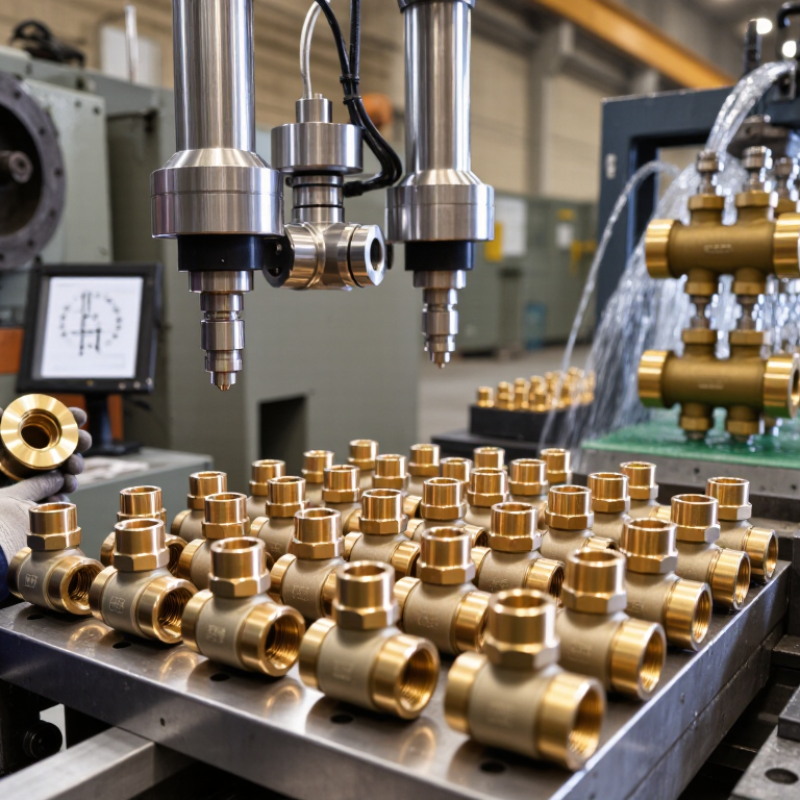
A brass ball angle valve combines a quarter-turn ball mechanism with a bent body. The angled body changes pipe direction, often from a wall outlet to a flexible supply line. Inside, a drilled brass ball rotates against sealing seats. The open position creates a direct passage with relatively low resistance. A 90-degree handle movement stops water quickly.
In practical plumbing work, this design saves space behind toilets, sinks, and compact cabinets. Its core flow function is isolation, not precise throttling. Partially closing the handle may damage seats or create turbulence over time. A full-bore passage usually supports better flow than a reduced-bore passage. However, performance also depends on port size, pressure, pipe length, and connector design.
Reliable selection requires more than checking the material label. Confirm working pressure, temperature range, thread standard, seal material, and media compatibility. Brass offers strength and good machinability, but water chemistry can affect service life. During installation, align the valve without twisting the pipe. Open it slowly, inspect every joint, and retest at normal pressure. Small leaks are not harmless. They often cause cabinet damage later. No valve is perfect, and installation mistakes can undermine excellent machining. That limitation deserves honest attention when evaluating an angle valve manufacturer in China.
For a China-based angle valve and brass ball valve manufacturer, material selection starts with the wetted components. EN 12165 covers copper and copper-alloy forging stock used in valve production. Suitable grades may include low-lead brass or dezincification-resistant brass, depending on the application and purchasing specification. The alloy must be verified by chemical analysis, not by its trade description alone. Lead content should remain controlled from billet procurement through machining.
NSF/ANSI 61 focuses on drinking-water contact safety. Its lead requirements are determined through extraction testing, and limits vary by product category, contact area, and test conditions. A material certificate alone cannot replace finished-product evaluation. For U.S. compliance, wetted brass parts should also meet the 0.25% maximum weighted-average lead requirement under applicable federal rules. The supplier should provide traceable test reports, production records, and clear component lists.
Practical inspections should check valve bodies, stems, balls, and internal inserts separately. Surface coatings do not automatically solve a high-lead alloy problem. In factory audits, missing batch links are a common weakness. Small records matter. Manufacturers should review supplier certificates against independent laboratory results and retain samples from each production lot. Compliance can fail through an overlooked washer or machining chip, so the design review should remain cautious and repeatable.
A reliable China angle valve brass ball valve manufacturer treats testing as a production routine, not a paperwork exercise. Each valve is checked under controlled pressure before shipment. Clean water is normally used for hydrostatic testing. Calibrated gauges record shell and seat pressure separately. This helps reveal casting pores, weak threads, or damaged sealing surfaces. EN 13828 guides performance checks for manually operated copper-alloy valves used in water installations. ISO 5208 provides leakage classifications and test methods for industrial valves. The exact pressure depends on the valve design, rating, and agreed test plan.
Temperature also changes test results. Seals can soften, contract, or lose elasticity after conditioning. A practical test sequence allows the valve to reach the required temperature before pressure is applied.
Operators inspect the stem, ball, body joint, and outlet connection closely. No visible leakage should appear where the specified acceptance level requires tightness. Tiny drops matter.
Testing is not always perfect. A clean result can hide poor sampling or an unstable gauge. That deserves review. Experienced inspectors repeat doubtful tests and record ambient temperature, medium, pressure, and holding time. They also cycle the handle before and after testing. This exposes stiff movement and incomplete shutoff. A failed valve is separated, traced to its batch, and examined rather than quietly retested. That discipline supports dependable field performance, even when production pressure is high.
A capable Chinese manufacturer should show a clear size range, not a vague “full range” claim. Check inlet sizes, outlet threads, wall thickness, and handle clearance on drawings. Confirm whether DN15, DN20, and DN25 models share the same body design. The difference matters during installation.
PN ratings also need careful reading. EN 1333 defines PN as a nominal pressure designation, not a universal working pressure at every temperature. Ask for pressure-temperature tables based on the actual brass alloy, seal material, and test medium. ISO 5208:2015 defines six leakage rates for industrial valves, including Rate A, which requires no visible leakage during testing.
Quality evidence should be traceable. Request batch numbers, casting inspection records, torque results, hydrostatic tests, and final leakage reports. ISO 2859-1 provides a recognized sampling approach, but sampling alone cannot replace process control. A useful supplier should explain its inspection level and acceptance limits.
UN Comtrade places many valve products under broad HS 8481 categories, so export volume cannot prove angle-valve expertise. Factory capacity can look impressive on paper, yet small-batch consistency may remain uncertain.
Tips: Compare three recent batch reports, not one perfect sample. Verify the test pressure, test duration, gauge calibration, and rejected quantity. Ask for photos with date labels. One weakness remains common: some reports copy standard language without linking results to serial numbers. Treat that gap as a risk, not a minor paperwork issue.
China Top Angle Valve Brass Ball Valve Manufacturer?
A reliable manufacturer should prove more than a polished catalog. Ask for a valid ISO 9001 certificate, then check its issuing body, scope, and expiry date. Product approvals must match the application and destination. For potable water projects, NSF/ANSI 61, WRAS, or equivalent approvals may be relevant. These certificates do not replace technical inspection.
Factory testing should include shell pressure, seat leakage, operating torque, thread accuracy, and visual checks. Request test pressure, duration, acceptance criteria, and sample reports. Material traceability also matters. A serious factory can link brass heat numbers to production batches and inspection records. Random samples should be checked by an independent laboratory when the project is sensitive.
Tips: Request a live video audit or an independent factory inspection. Review anonymized export documents, repeat-order evidence, and destination markets. Confirm whether records show actual shipments, not only trading claims. Ask for packaging photos, carton markings, and loading details. I would also compare several batches, because one perfect report proves little. Small weaknesses, such as inconsistent plating or stiff handles, may appear only during repeated testing. That is where reliability becomes visible.
| Evidence Category | Recognized Standard or Record | What It Demonstrates | Documents to Request | Recommended Verification |
|---|---|---|---|---|
| Quality management | ISO 9001:2015 | A documented quality-management system covering production controls, corrective actions, traceability, and continual improvement. | Valid certificate, certification scope, issuing-body name, certificate number, and expiry date. | Confirm the certificate directly through the issuing certification body and check that valve manufacturing is within its scope. |
| Product design reference | EN 13828 | Requirements and tests for manually operated copper-alloy ball valves used in water-supply applications, where applicable to the product design. | Declaration of conformity, product test report, technical drawing, and applicable size or pressure range. | Check that the tested construction, materials, dimensions, and pressure rating match the supplied angle valve. |
| Pressure and leakage testing | EN 12266-1 or ISO 5208, as specified in the purchase agreement | Evidence that the valve body, seat, and closure have been tested for pressure resistance and leakage. | Batch pressure-test report showing test medium, pressure, duration, acceptance criteria, quantity, and result. | Require batch or serial-number traceability and compare the test pressure with the declared working pressure. |
| Material verification | EN 12165, EN 12164, ASTM B16, or an agreed equivalent | Confirms that copper-alloy components are manufactured to a recognized chemical-composition and mechanical-property specification. | Mill test certificate, heat number, alloy designation, chemical composition, and mechanical-test results. | Match the heat number on the material certificate with production or incoming-inspection records. |
| Inspection documentation | EN 10204:2004, particularly Type 3.1 when contractually required | Provides a controlled inspection certificate linking supplied material to specified test results. | Signed inspection certificate identifying the material, order, heat number, and applicable test results. | Verify that the certificate is issued by the manufacturer or an authorized inspection representative, not an untraceable template. |
| Potable-water suitability | WRAS, NSF/ANSI/CAN 61, ACS, or another market-specific approval | May demonstrate suitability for contact with drinking water, but only for the approved product, materials, configuration, and use conditions. | Current approval certificate, listing entry, approved model range, material limitations, and validity period. | Search the certification body’s public database and confirm the exact model, seal materials, and intended market. |
| Dimensional conformity | Applicable thread standard, such as ISO 7-1, ISO 228-1, or ASME B1.20.1 | Confirms that inlet and outlet threads are compatible with the specified piping system and sealing method. | Approved drawing, thread-gauge records, dimensional inspection report, and product marking details. | Use the correct calibrated gauges and verify thread type separately; do not assume BSP and NPT are interchangeable. |
| Production-process control | Documented incoming, in-process, and final inspection procedures | Shows that casting, machining, deburring, assembly, sealing, marking, and packaging are controlled systematically. | Quality-control plan, inspection checklist, calibration records, nonconformance procedure, and corrective-action examples. | Conduct a remote or on-site audit and sample records from more than one production batch. |
| Packaging and shipment control | Purchase-order packaging specification and agreed export-marking requirements | Reduces the risk of corrosion, thread damage, mixed models, incorrect quantities, and transit-related damage. | Packing-list photos, carton labels, pallet details, quantity reconciliation, and pre-shipment inspection report. | Compare carton markings and quantities with the purchase order and final inspection release. |
| Export-history evidence | Verified bills of lading, customs declarations, or trade-document records | Shows documented shipment activity, product descriptions, destination markets, shipment dates, and quantities; it does not by itself prove product quality. | Redacted bill of lading, commercial invoice, packing list, certificate of origin, and customs or freight-forwarder confirmation. | Check consistency among dates, quantities, product descriptions, ports, and declared exporter information. |
| Independent pre-shipment inspection | Inspection based on an agreed sampling plan, such as ISO 2859-1 | Provides an independent check of quantity, appearance, dimensions, function, packaging, and selected pressure-test records before shipment. | Signed inspection report, sampling level, acceptance criteria, photographs, defect classification, and release status. | Ensure the inspection agency, sampling plan, and acceptance limits are agreed before production begins. |
| Supplier due diligence | Business registration, factory address, production-capability review, and audit trail | Helps establish that the trading entity, manufacturing location, equipment, and documented quality system are consistent. | Business-license extract, facility photographs or video audit, equipment list, organization chart, and subcontractor disclosure. | Cross-check the legal entity, factory address, certificates, bank details, and export documents for consistency. |
Note: Certification requirements depend on the destination country, application, pressure rating, materials, and potable-water contact. Export records demonstrate shipment history, but they should be evaluated together with valid certificates, traceable factory-test reports, and independent inspection evidence.
Suitable options include low-lead brass and dezincification-resistant brass. The choice depends on application and purchasing requirements. Verify alloy chemistry through laboratory analysis. Do not rely on trade descriptions alone.
Control lead from billet purchasing through machining. Check bodies, stems, balls, and inserts separately. For U.S. projects, wetted brass should meet the 0.25% weighted-average limit. Surface coating cannot correct a high-lead alloy.
No. A material certificate is not enough. Finished products need extraction testing under applicable conditions. Limits may vary by product category, contact area, and test method. A missing component can still create risk.
Request drawings for inlet sizes, outlet threads, wall thickness, and handle clearance. Check DN15, DN20, and DN25 models separately. They may not share the same body design. Installation differences matter.
Treat PN as a nominal pressure designation. It is not universal working pressure at every temperature. Ask for pressure-temperature tables. Tables should identify the brass alloy, seals, and test medium.
Request shell pressure, seat leakage, torque, thread, and visual inspection results. Check test pressure and test duration. Confirm gauge calibration and acceptance limits. One perfect report proves little.
ISO 5208:2015 defines six leakage rates. Rate A requires no visible leakage during testing. Ask which rate applies to the valve. The test medium and duration should be recorded.
Request batch numbers, casting records, torque results, hydrostatic tests, and leakage reports. Trace brass heat numbers to production batches. Compare at least three recent batch reports. Paperwork can still hide weak traceability.
No. Broad customs categories may include many valve products. Export volume does not prove angle-valve specialization. Review repeat orders, destination markets, and shipment records. Capacity may look impressive, yet small-batch consistency remains uncertain.
Selecting a reliable China Angle Valve Brass Ball Valve manufacturer requires more than comparing price. A brass ball angle valve combines an angled body with a quarter-turn ball mechanism to control and isolate water or fluid flow efficiently in compact installations. Material selection is essential: manufacturers should demonstrate compliance with EN 12165 for copper alloy products and meet applicable lead-limit requirements under NSF/ANSI 61. Product evaluation should also consider the available size range, connection options, pressure ratings, temperature limits, and suitability for potable-water applications.
Quality assurance should be supported by documented pressure, temperature, and leakage tests conducted in line with EN 13828 and ISO 5208 principles. Buyers should request inspection records, dimensional reports, batch traceability, factory testing procedures, and evidence of consistent production control. Certifications, independent test results, quality-system documentation, and verifiable export experience can further demonstrate reliability. A manufacturer that provides transparent technical data and repeatable inspection results is better positioned to deliver safe, durable, and consistent Angle Valve Brass Ball Valve products.
